Five minutes at a time, it accumulated to 1,442 hours on social media in one year. And my notifications were already off.
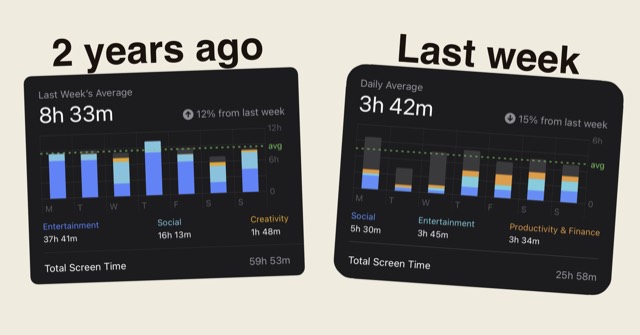
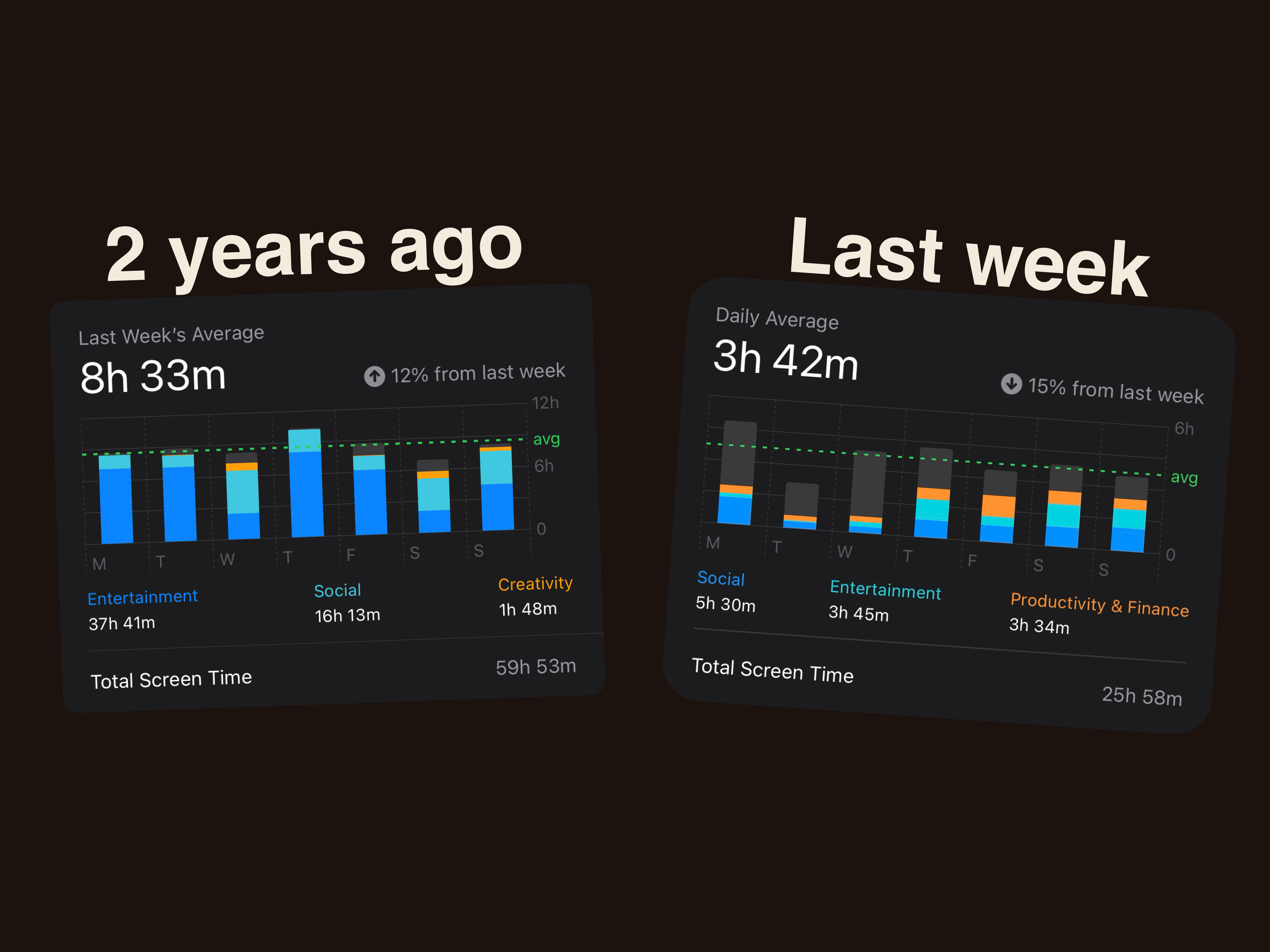
Two years ago, my screen time was 8h33m a day. My last four-week average was 3-4 hours.
Willpower alone didn’t do it.
On June 17, 2009, any app on iPhone OS 3 could interrupt you. You allow it once and you forever see it when you open your phone. You saw a popup someone chose for you with a goal you didn’t set.
It’s not only your phone. Every tool comes with defaults. Settings someone else chose for everyone, and you inherited them.
There is a saying I keep coming back to: “Every notification is an alarm set by someone else.”
So how much of your day is designed by you? Look at the last thing that interrupted you: did you choose it?
What did your phone interrupt you for today?At 27, I downloaded an app blocker. After connecting my screen time, it showed me this.
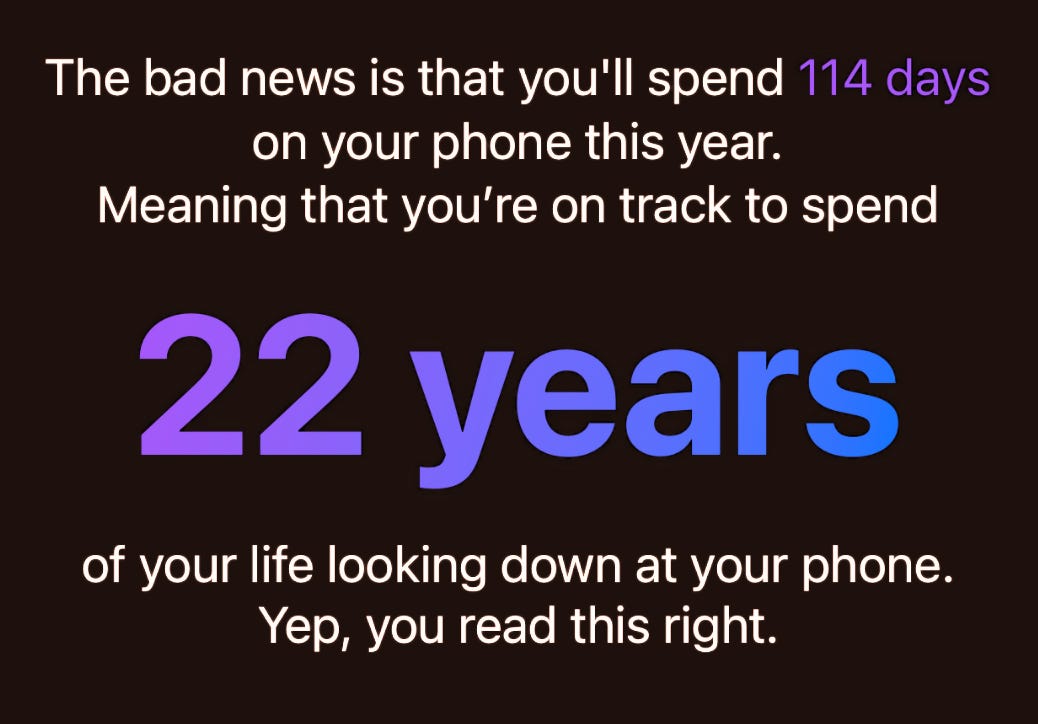
The number that broke me was 114 days on my phone in one year. That’s 7.5 hours a day. At that pace, the app said I was on track to spend 22 years of my life looking down at my phone.
When I saw the image above, it was the nail in the coffin that a change was needed. But it’s not your fault or mine. It’s not your fault that your phone pulls you back, but it’s your job to protect your time.
Companies spent years and millions of dollars removing barriers to make our phone and tools easy to access and frictionless as possible.
Every time you check your phone you’re basically saying, “This alarm that someone sent me needs my time right now.” You are sending a signal to yourself: “I’ll stop whatever I’m doing to put other people’s priorities and random app notifications above mine no matter who they are or what it is.”
Why willpower losesTwo years ago I turned notifications off. I was scared I would miss something important, but there wasn’t anything to miss. But the habit of checking my phone was still there. Every couple of minutes I checked my phone to later find out most of my apps were blocked. I felt uneasy and my brain started looking for ways around the blocker.
I would remove the block for 5 minutes, only to later find out I had spent all my unblock time for that day. Even with it blocked my hand would reach out for the phone and my thumb would automatically go to where Instagram used to be and tap it.
My hand knew the path to Instagram better than I knew what I actually wanted in that moment.
I kept waiting to be disciplined enough to protect my time, but every app adds another addiction, another notification, another setting, another switch to steal my attention. That’s what it’s all about.
I understood that I needed to change that habit and build a system around how I use my phone and where I spend my attention.
Build a system, or it will build one for you.
I removed the invitation to be interruptedMy rule was simple: I kept my messaging app for the people who actually need to reach me, set it to do not disturb so it only pulls me in when I open it on my own terms, and blocked the endless social apps that never carried urgency anyway.
If your job or family depends on certain calls, messages, or alerts getting through, keep those select few channels and silence everything else.
You are not removing access; you are removing the invitation, and you can still check the essentials when you choose to.
Try it one day. Name the one app your thumb opens without asking you. Remove all notifications and keep only one messaging platform with do not disturb on.
At 3h42m a day now, the same math gives 11 years instead of 22.
I didn’t need more discipline. I needed to change my habit and think of my phone as a tool.
If you want to get updates about how it’s going, click subscribe to follow along.
P.S. I’m buying an E-Ink reader that runs on Android to be my main tool, with the computer second and the phone third. The goal: read, write, and produce more than I consume.