Every person I’ve seen move fast with AI and have high-quality progress this year had one thing in common: none of them started by learning AI.
This is a story about a design deck.
What My Uncle Couldn’t See in His Own AI Deck.I stopped by my uncle’s business to check in and give him a hand with something outside his usual workflow. My uncle handed me a design deck he was proud of. He told me he made it with AI in a couple of minutes.
It looked done and ready to send. But I could see five problems before the second slide.
The spacing was wrong,
The colors were off.
The hierarchy was weak.
The structure was messy.
And there was that feeling that something was just off.
He saw it as done. I saw five problems. We had the same AI. What did he not have, that I did?
Why Two People With the Same AI Produce Different ResultsSame AI. Opposite outcomes. The difference was whether the human knew which side he was on.
There is a gap between my uncle and AI. It’s not the AI or the way of using it.
The tool can help my uncle produce a deck, but it cannot give him the same library of experiences, failures, references, and instincts that I have in creative work.
My past is no longer baggage. It is the dataset that my eyes were trained on.
AI may democratize execution, but it does not democratize perspective.
He does not know the task he handed to AI has parts he cannot judge. He does not know what he cannot see. The spacing. The color. The hierarchy. That quiet feeling of “this is off” that comes from closing the loop thousands of times.
He has no map, but I do, from 12 years of building it one rep at a time.
There is a name for this, from a team of researchers at Harvard and Wharton.
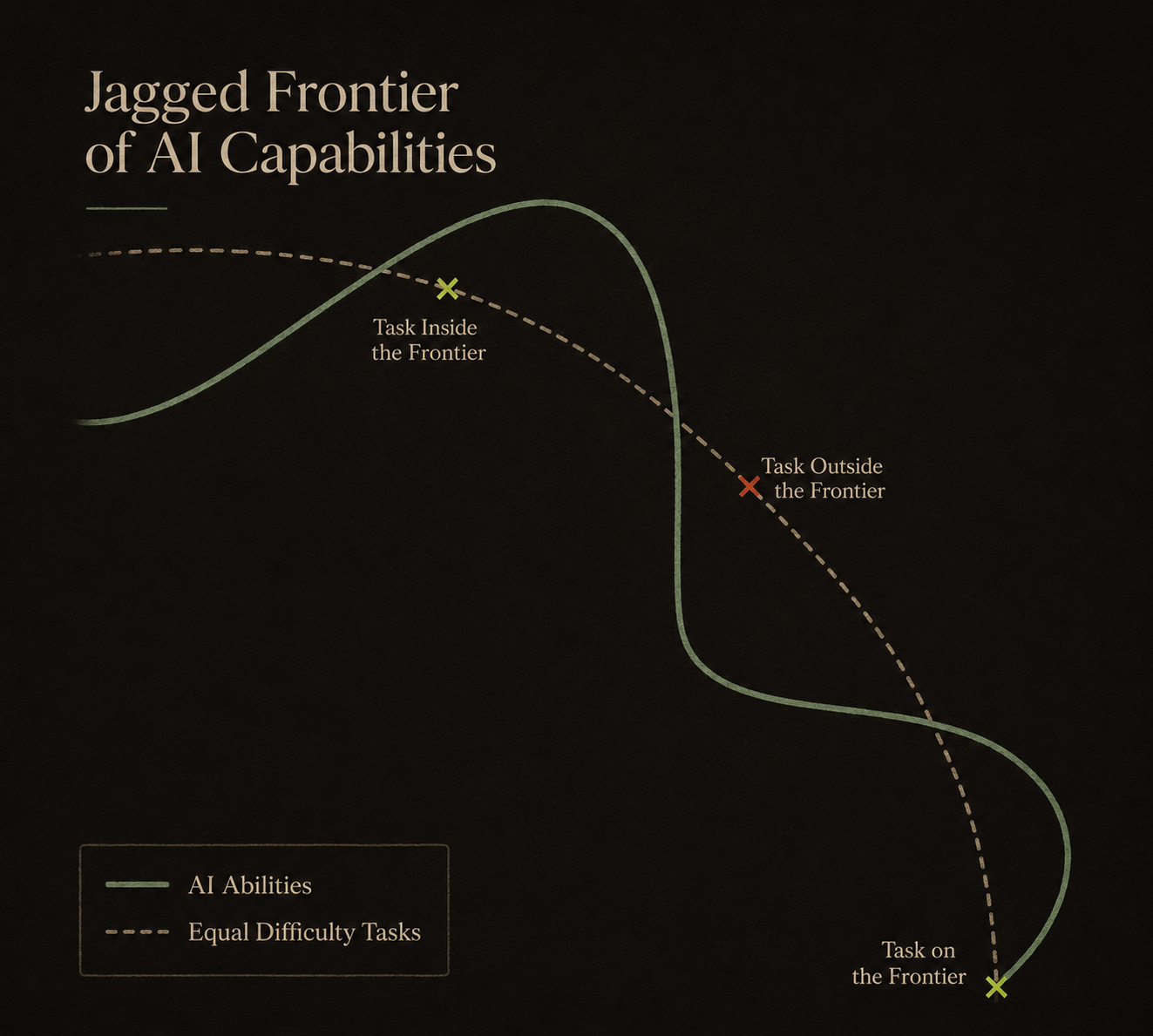
They ran an experiment with 758 consultants at Boston Consulting Group. They called it the jagged technological frontier.
They found that inside the frontier, AI users completed 12.2% more tasks, 25.1% faster and with high quality.
Outside the frontier, they were 19% less likely to produce correct solutions than people without AI.
AI capabilities are jagged. Experience is the map.
I picked up a camera in 2014 as a hobby to practice photography, transitioned to video, and while going in the classic academic path I did some client work as well and became a big part after I graduated from computer science bachelor
All these years whenever I pick up a camera, a loop was created; and it would go like this:
Do the work
Come back and see the results
Edit to improve the result.
Compare my work with the industry leader at that time.
See and understand what’s wrong to improve next time.
Pick up the camera next time to repeat the loop.
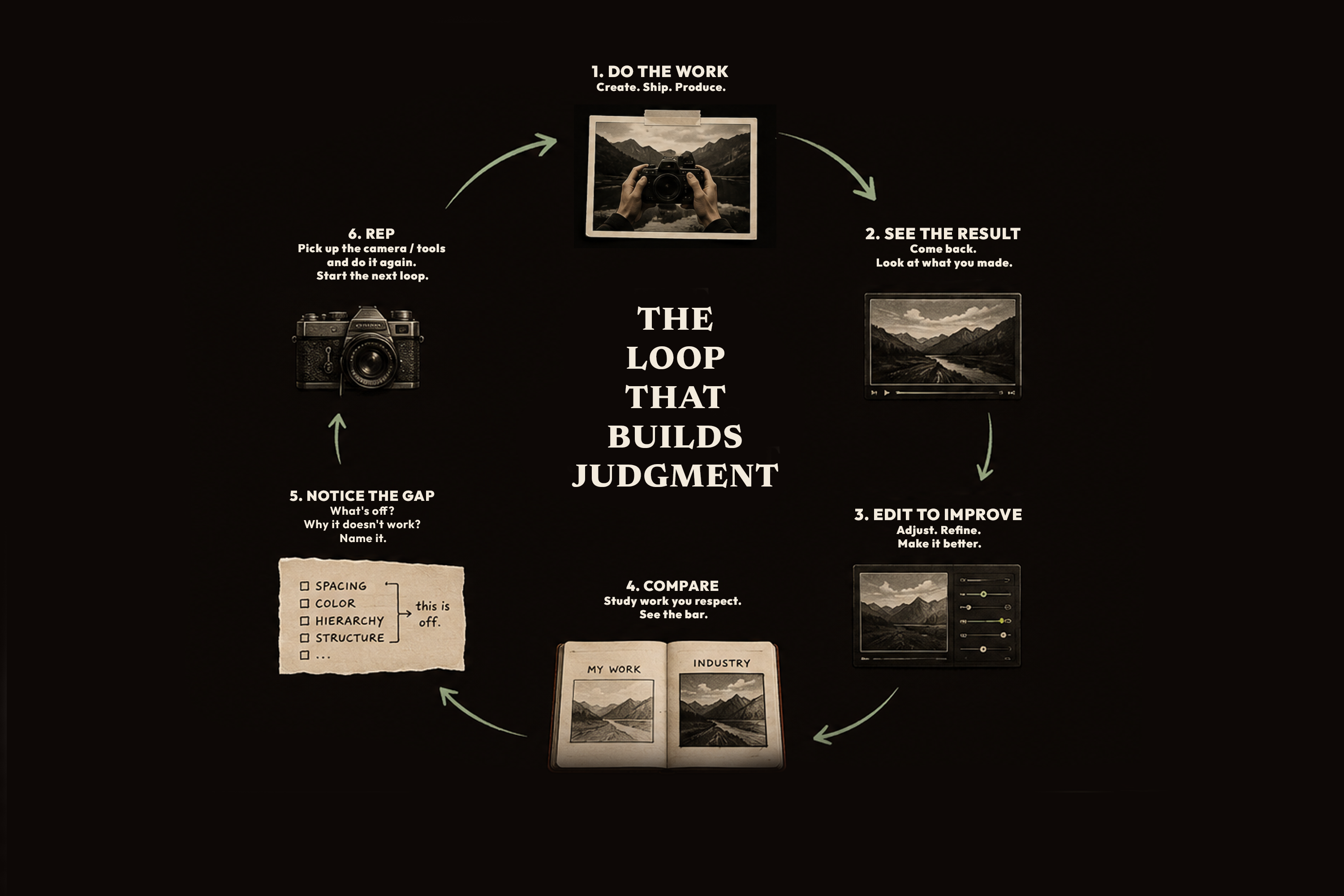
That loop, done thousands of times, shaped my taste and artistic eye, so to speak.
When my uncle handed me that design deck, I was not looking at five problems. I was looking at 12 years of closing the gap between what I wanted and what I got.
If I gave you the best camera that is used in Hollywood to make a short film, you will not output the same short film as Christopher Nolan, not because you lack the right tool, but because you lack the years of shooting.
Christopher knows the gap between the shot in his head and the shot he want on screen because he has closed this loop thousand times, but you didn’t.
AI does not close that gap for you. It just gives you a faster camera. The gap is still yours to close.
How to Close the Gap (and a Question I Cannot Answer)Select the task
Before you touch this new technology ask yourself, have I done this task without AI enough times to recognize good from average?
Direct it with context
Direct your AI with constraints, references, taste. The machine needs material to multiply
Verify outside the chat
When you have the results, ask yourself what you are checking against? What is the standard results for this task?
Open the output and judge it the way you would judge human work. If you can’t articulate what is off, you are not ready to use AI for this task.
My uncle started to close that loop more with AI.
He creates. I tell him what is off. He closes the loop by fixing it. Each cycle trains his eye.
One person creates, another judges, and the first closes the gap. each cycle training the eye.
AI is now democratized. The next generation will grow up with it, the way we grew up with cable TV and the internet. How do they build the eye? How do they develop taste when the first pass is always done for them?
I do not have an answer. I suspect the answer is not using AI less, but doing more reps on human work before handing anything to the machine
I’m still figuring this out, same as you.
— Youssef