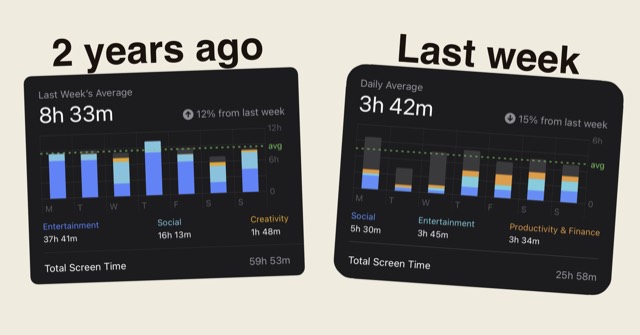
You think you need more tools, courses and knowledge to start taking action on your goal.
Most people think AI will make knowledge less valuable. I think it will make it valuable in this age.
Artificial intelligence can output quickly, but the edge comes from knowing what to build and having experience, judgment and context to connect the dots.
You already have more of those dots than you think.
When Learning Becomes a Way to Avoid Doing
In 2015, after graduating from high school, I started studying computer science. Alongside studying, I began collecting skills one after the other.
I thought each new skill would help me figuring out what I should do, even though I had no clear direction.
In the last 10 years, I accumulated different set of skills across different areas.
I learned programming because I wanted to study computer science.
From 2017, I wanted to become a content creator. That made me learn design and video editing because I wanted to make the videos myself.
I learned magic because I wanted to be cool.

I kept learning because I’m a curious person and I can’t stop myself from diving deep in YouTube rabbit holes.
At that time, they felt unrelated. I thought the problem was that I needed to learn more.
But the problem was much more simple. I had no clear direction for those skills or a correct way to apply them in the real world.
I could build and design a website, understand the psychology of content strategy, and create different workflows. But I could not see how those pieces would serve one clear direction.
Because I could not see one future, I kept learning other tools rather than shipping work and getting things done. When I had to choose what to build or focus on, I got stuck.
I would spend more time adjusting the workflows than doing actual work.
Every new skill felt like an escape from doing real work.
I was not failing because I lacked ability. I was failing because my skills didn’t have a direction.
My curiosity was real, but it also gave me a respectable way to avoid judgment and avoid testing myself.
The direction was not a job title. It was a problem I wanted to help solve: helping curious people turn scattered knowledge into clear direction, capable systems, and better work.
The Weekly 1% gave me a place to turn that direction into public work:
Once I started trying to build The Weekly 1%, each skill got a job:
Programming helped me build the website.
Design thought me how to make ideas easier to understand visually.
Video content allowed me to communicate an idea clearly enough for people to care.
Magic gave me perspective to understand attention, expectation and surprise.
The Advantage AI Cannot Create for You
You can’t connect the dots looking forward; you can only connect them looking backwards.
- Steve Jobs
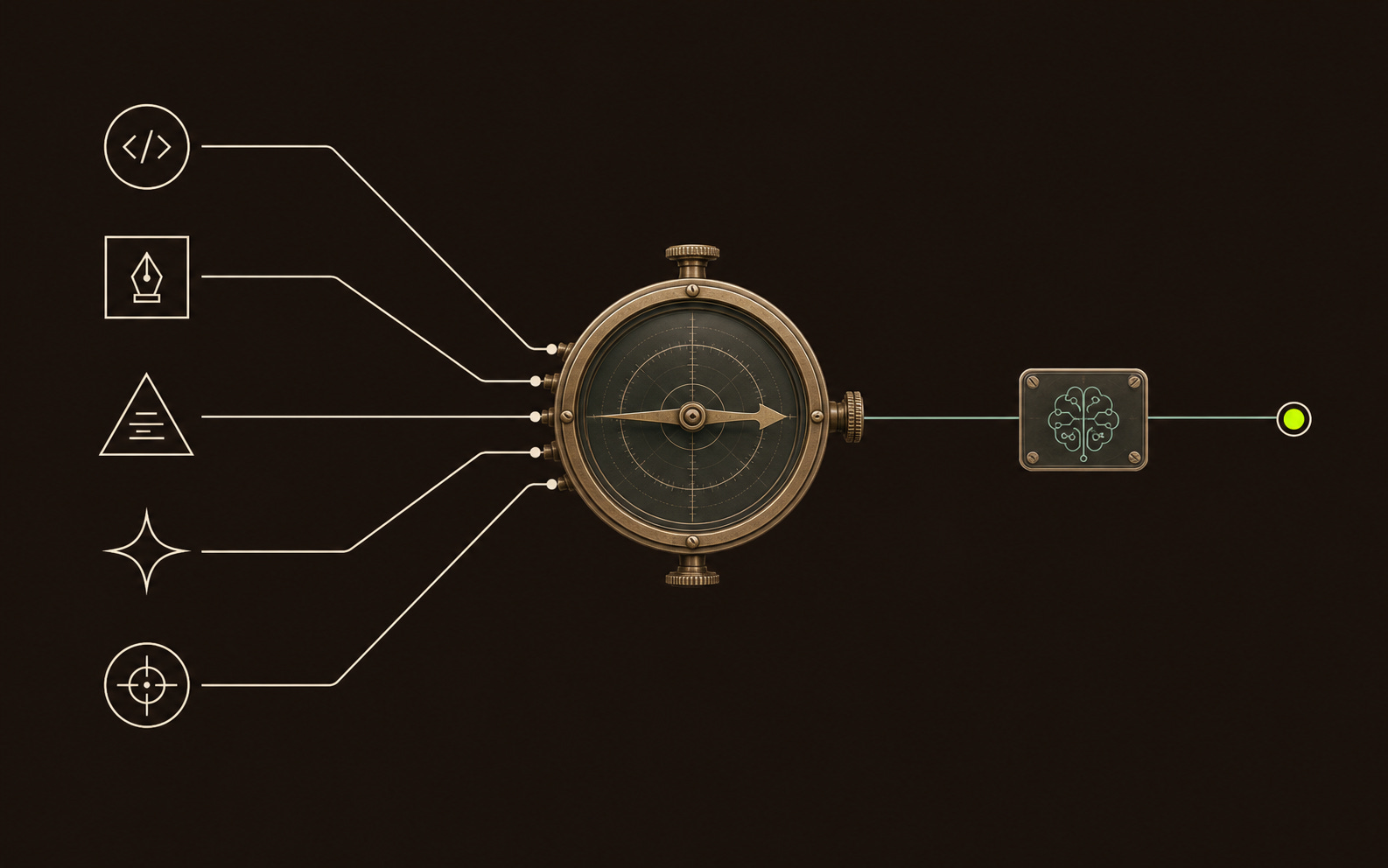
Steve Jobs was right: you only connect the dots looking backward.
You already have enough starting dots to get you somewhere faster than you think.
AI is not automatically rewarding the people with the newest skills.
It rewards people who have more useful dots to connect.
If you know the concept of “second brain” you can tell the AI to build you one.
But if you don’t, you spend 3-4 hours explaining the outcome.
The filmmaker sees structure.
The writer sees clarity.
The knowledge worker sees the decision.
The designer sees taste.
The tools are new.
AI lowers the cost of execution.
Your past experience gives you better hypotheses, constraints, keywords, and taste. That does not guarantee a perfect outcome.
It gives you a better starting position to test.
But the advantage comes from everything you learned before they existed.
Give Your Skills a Job
You collect courses, tools, notes and prompts without moving the needle forward.
Obsessing on these elements is another way to avoid focus.
You feel like you are moving forward towards your goal. Yet, you are running in circles trying to advance.
There’s an old saying: “Give me six hours to chop down a tree and I will spend the first four sharpening the axe.”
But some of us keep sharpening the axe long after it is ready.
That looks like rebuilding the same workflow for the 954th time, jumping from tool to tool, buying new courses and using different prompts and processes to get the same result.
You do not need to find the next skill that will make you the most money, fame or power. But you need to give your existing skills a job and a simple workflow to support it.
You avoid giving them a job because you are afraid of choosing the wrong direction or wasting potential.
Keeping the system unfinished feels safer than letting the work be seen.
Direction is not a fancy job title, it’s a problem you want to solve for a specific person you want to help.
Once you choose a problem to solve, you have a filter. Courses, tools, and prompts that do not help you solve it can wait.
Instead of asking, “What should I learn next?” ask, “What can I make with what I already know that could help this person?”
This week’s 1%: connect your past dotsIf this feels familiar, I made something for you.
Connect Your Past Dots helps you look at your past dots, skills, interests, half-finished projects, and rabbit holes you have collected. Then see the directions they could point toward.
If it gives you one direction worth following, give it a week.
You are not trying to explain your whole past.
You are trying to find one thing worth making next.
Either way, you stop guessing and get an answer from doing the work.
— Youssef